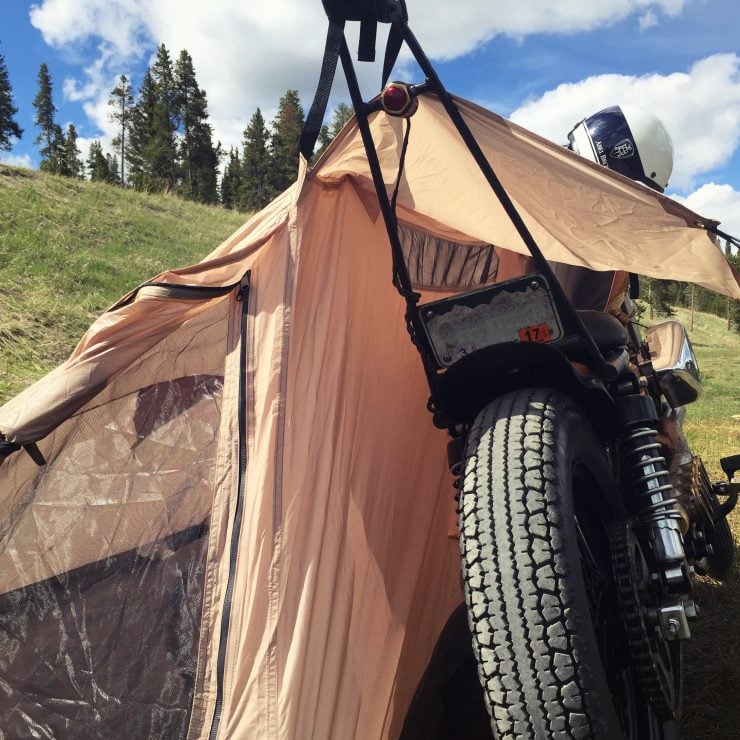
Learn How To Strap A Tent To A Motorcycle with secure tie-down methods, the right straps, balanced loading, and essential safety checks. To strap a tent to a motorcycle, roll it tightly, place it securely on the passenger seat or rear luggage rack, and fasten it with two or more suitable tie-down straps.
Attach the straps to strong frame or rack points, tighten them evenly, and check that the tent cannot move or touch the exhaust, tires, chain, or other moving parts.
Planning a motorcycle campingtrip across the United States means making good use of limited storage space. Whether you are riding through the Rocky Mountains, exploring national forests in Colorado, or taking a weekend trip along the Pacific Coast, your camping gear must stay secure throughout the ride. A tent is often one of the largest items to carry, but its soft shape makes it easier to pack than many other camping supplies.
The best way to carry a tent is to roll it into a compact bundle and secure it close to the center of the motorcycle. A rear luggage rack, passenger seat, or suitable pannier system can provide a practical mounting area. The right setup depends on your motorcycle, tent size, available attachment points, and the weight limits listed by the manufacturer.
This guide explains how to strap a tent to a motorcycle step by step. It also covers strap choices, packing methods, attachment points, weather protection, and common mistakes. These details can help you carry your camping equipment without creating unnecessary risks for yourself or other road users.
How To Strap A Tent To A Motorcycle?
How To Strap A Tent To A Motorcycle
Source: cdn.motor1.com
Why Properly Strapping A Tent To A Motorcycle Matters
A tent that moves during a ride can affect motorcycle balance and create a road hazard. Even a lightweight tent can become dangerous if its straps loosen or the bundle shifts toward the rear wheel. Wind pressure and road vibration can also cause poorly secured equipment to move.
Motorcycles have less storage space than cars, so riders must think carefully about where each item goes. A tent should not interfere with the rider’s position, steering, lights, suspension, or access to controls. Keeping the load compact and balanced helps maintain more predictable handling.
Weight placement matters as much as strap tension. Motorcycle safety guidance from transportation authorities and manufacturers generally recommends keeping cargo low, close to the motorcycle’s center, and evenly distributed. Heavy loads placed too far behind the rear axle can affect stability, steering, and braking.
A low, centered tent bundle helps avoid unnecessary changes to the motorcycle’s center of gravity.
Less movement during travel
Proper straps prevent the tent from sliding, bouncing, or rotating when the motorcycle travels over uneven roads.
Protection for camping gear
A compact, covered tent bundle is less exposed to road dirt, rain, dust, and wind.
Fewer roadside problems
A secure setup reduces the need to stop repeatedly to reposition loose camping equipment.
How To Strap A Tent To A Motorcycle?
Check Your Motorcycle’s Weight Limits First
Before attaching a tent, check the maximum payload in your motorcycle owner’s manual. The payload includes the rider, passenger, luggage, accessories, and other carried items. A rear rack or top case may also have a separate weight limit that is lower than the motorcycle’s total payload.
Do not assume that a strong-looking metal rack can support any load. Its mounting hardware and the motorcycle’s subframe also have limits. If the tent and other camping equipment exceed an approved limit, remove unnecessary items or use a different carrying arrangement.
Read the owner’s manual
Find the motorcycle’s maximum payload and any special luggage instructions.
Check the rack rating
Follow the stated capacity for the rear rack, panniers, and luggage accessories.
Consider total cargo
Include the tent, sleeping bag, sleeping pad, tools, water, and other camping supplies when calculating the load.
What You Need To Strap A Tent To A Motorcycle
Gather the right equipment before packing your tent. You do not need a complicated luggage system for every trip, but you do need straps that can hold the tent firmly without damaging the motorcycle or camping gear.
Motorcycle luggage straps with adjustable buckles are a practical choice. They allow you to apply controlled tension and make adjustments when the load settles. Choose straps that are suitable for the load and have no damaged webbing, weak stitching, or worn buckles.
A waterproof storage bag is also useful. Many tent stuff sacks provide basic protection, but they may not keep water out during prolonged rain. A properly closed dry bag can offer an additional layer of protection.
How To Strap A Tent To A Motorcycle?
How To Strap A Tent To A Motorcycle
Source: i.ytimg.com
Cam buckle straps
These straps allow controlled tightening and are suitable for many lightweight and medium-sized motorcycle luggage loads when properly rated.
Motorcycle luggage straps
Specially designed luggage straps often have flexible mounting loops that attach to suitable motorcycle anchor points.
Waterproof dry bag
A dry bag protects the tent from rain, splashes, dust, and road debris.
Protective padding
Soft padding can help protect the tent fabric from abrasion where it touches luggage racks or other equipment.
Spare strap
An extra strap provides a backup if a buckle becomes damaged or a mounting arrangement needs adjustment.
Which Straps Are Best For Motorcycle Camping?
Cam buckle straps are a useful starting point because they provide controlled tension without requiring a ratchet mechanism. They are suitable for many tent bundles and soft luggage setups. Choose a length that allows secure attachment without leaving excessive loose webbing.
ROK-style adjustable motorcycle straps combine elastic sections with webbing. Their design can help accommodate soft luggage, but the amount of stretch means they should not be assumed to prevent every direction of movement. Follow the manufacturer’s load and use instructions.
Ratchet straps can secure certain heavy loads, but they may apply too much force to a soft tent bundle or a light luggage rack. If used, tighten them carefully and avoid crushing tent poles or bending mounting hardware.
Best general option
Use suitable cam buckle motorcycle luggage straps for controlled tension and simple adjustments.
For flexible luggage setups
Consider motorcycle-specific adjustable straps when their rated capacity and mounting design match the load.
Use extra care with ratchet straps
Avoid excessive tension that can damage tent poles, fabric, luggage racks, or mounting points.
Avoid relying on ordinary bungee cords
Elastic cords can stretch, loosen, or release their hooks. They should not be the primary restraint for a tent carried at road speed.
How To Strap A Tent To A Motorcycle?
Prepare Your Tent Before Loading
Make sure the tent is completely dry before packing it whenever possible. Storing a wet tent for a long period can encourage mold and damage the fabric. If the tent is damp after camping, dry it at the next suitable opportunity.
Remove loose dirt and shake out small stones or debris. Fold the fabric neatly, arrange the poles in their protective sleeve, and place the smaller accessories in a separate bag. This makes the main bundle easier to compress and secure.
Pack poles separately
Keep tent poles in their sleeve to prevent their ends from damaging the tent fabric.
Compress the fabric
Remove excess air and fold or roll the tent into a compact shape.
Close the storage bag
Make sure all openings and closures are secured before mounting the tent.
How To Strap A Tent To A Motorcycle Step By Step
The safest general approach is to place the tent on an approved luggage rack or passenger seat and secure it with multiple straps connected to strong, fixed mounting points. The exact routing depends on the motorcycle and the luggage system, so always follow the motorcycle and strap manufacturers’ instructions.
A simple arrangement uses one strap across the tent to hold it down and another routed in a different direction to help prevent forward or sideways movement. Larger or longer bundles may need additional straps. The aim is to stop the load from shifting in any direction, not simply to press it down.
How To Strap A Tent To A Motorcycle?
How To Strap A Tent To A Motorcycle
Source: i.ytimg.com
Step 1: Choose a suitable mounting position
Use an approved rear luggage rack, a compatible passenger-seat luggage system, or another properly rated mounting area.
Step 2: Position the tent
Place the rolled tent low and near the center of the motorcycle. Avoid excessive rear overhang.
Step 3: Find strong anchor points
Look for suitable fixed rack rails, frame attachment points, subframe loops, or approved grab rail mounting locations.
Step 4: Attach the first strap
Route the first strap over the tent and connect it to secure anchor points on opposite sides. Keep it flat and free from twists.
Step 5: Attach the second strap
Position another strap in a different direction to resist forward, rearward, and sideways movement.
Step 6: Tighten both straps
Apply even tension until the tent is held firmly. Avoid crushing the poles or damaging the fabric.
Step 7: Secure excess webbing
Fold or tuck loose strap ends so they cannot flap into the wheels, chain, exhaust, or other motorcycle parts.
Step 8: Test the entire setup
Push the tent forward, backward, sideways, and upward. Reposition or tighten the straps if the bundle shifts.
How To Strap A Tent To A Motorcycle?
Step 1: Select The Best Location For The Tent
The passenger seat and rear luggage rack are common places to carry a tent. A rack can provide a stable base when its capacity and mounting system are suitable. A passenger seat can also work with a compatible luggage carrier that prevents the bundle from sliding.
Place the tent as close to the center of the motorcycle as possible. Keep it low and avoid positioning the full weight behind the rear axle. If the tent is too long, consider separating its poles and fabric into different secured packages.
Useful for compact tents when a compatible carrier or secure mounting arrangement is available.
Side luggage system
Can work for separately packed tent components when the pannier system supports the load and maintains balanced weight distribution.
Step 2: Attach The Straps To Solid Points
Good attachment points are essential. Look for fixed frame or subframe loops, luggage rack rails, approved grab rails, and suitable passenger footpeg brackets. These points must be strong enough for the intended load and must not move during normal suspension operation.
Never attach a tent strap to an indicator, mirror, plastic body panel, license plate holder, brake line, or another part that is not designed to support luggage. Avoid suspension components and anything that rotates or moves with the wheel.
Check each attachment point before tightening. A strap that looks secure while the motorcycle is parked can still slide off a narrow or open bracket when the load shifts.
Use fixed mounting points
Choose suitable frame, subframe, or rack attachment locations.
Check the strap path
Make sure the strap cannot slide toward the rear wheel or another moving component.
Avoid sharp edges
Route webbing away from sharp metal edges that could cut or weaken it.
How To Strap A Tent To A Motorcycle?
Step 3: Use A Cross-Strap Arrangement
A crossed arrangement can provide better control than two straps running in exactly the same direction. For example, one strap can pass across the top of the tent from one side of the rack to the other. A second strap can run diagonally or in another direction that helps resist forward and backward movement.
The straps should work together without pulling the tent toward one side. Keep the buckles in accessible positions and make sure they cannot press against delicate tent components. If the tent is long or bulky, add suitable restraints as needed.
Do not assume that crossing straps automatically makes the load safe. The strength of the anchor points, strap condition, tension, and clearance from motorcycle components still determine whether the setup is suitable.
First strap
Holds the tent down across the main body of the bundle.
Second strap
Helps control movement in another direction, especially forward and sideways movement.
Additional straps
Provide extra restraint for longer or larger tent bundles when properly positioned.
How To Strap A Tent To A Motorcycle
Step 4: Tighten And Test The Tent
Tighten the straps gradually and check the pressure on both sides. The tent should remain stable without being squeezed so hard that the fabric, pole sections, or rack become damaged.
Hold the motorcycle securely and push the tent in several directions with firm hand pressure. Check for sliding, rotation, lifting, and changes in strap tension. If the tent moves, change the routing or mounting points rather than simply pulling every strap tighter.
After the test, sit on the motorcycle and check that your riding position remains comfortable. Make sure the tent does not interfere with the passenger seat, your legs, or any normal riding movement.
Check forward movement
The tent should not slide toward the rider or fuel tank.
Check sideways movement
The bundle should not shift toward either side of the motorcycle.
Check upward movement
The tent should not lift or bounce when you pull it gently upward.
Where Should You Carry A Tent On A Motorcycle?
The best location depends on the motorcycle’s design, the tent’s dimensions, and the available luggage equipment. A rear rack is often a convenient choice because it provides a defined platform. However, a passenger seat luggage system or compatible pannier arrangement may be more suitable for a particular motorcycle.
The main rule is to keep the luggage close to the motorcycle’s center and avoid adding excessive weight high or far behind the rear axle. You should also leave enough space for the rider to move naturally and operate the motorcycle without interference.
The following table compares common carrying positions. It is a general planning guide, not a substitute for the weight limits and mounting instructions for your specific motorcycle.
Can carry tent components separately and help distribute cargo when the system is loaded within its limits.
Top case
May provide storage for a compact tent, provided the case dimensions and manufacturer capacity allow it.
Rear Luggage Rack
A rear luggage rack is often the most straightforward place to secure a tent. Its flat surface can support a compact bundle, while rack rails or approved loops can provide attachment points. Use a protective layer if the rack has edges that may rub against the tent bag.
Check the rack’s rated capacity before loading it. A large tent can create a long rear overhang, so make sure the bundle does not extend into lights, turn signals, the license plate, or other equipment.
Main benefit
Provides a defined mounting surface for compact camping equipment.
Main limitation
Rack capacity and rear overhang may restrict the size and weight of the tent.
How To Strap A Tent To A Motorcycle?
Passenger Seat
A passenger seatcan be useful when your motorcycle has no rear rack. A suitable luggage carrier can help distribute pressure and provide secure strap routes. Do not place a tent directly on the seat and assume that ordinary seat straps will hold it safely.
Check that the bundle does not push against your back, limit your movement, or interfere with passenger arrangements. Never carry a passenger unless the complete setup is designed to accommodate one safely.
Main benefit
Provides an alternative mounting area for small, lightweight tents.
Main limitation
Can reduce passenger space and may affect rider comfort.
Panniers And Side Luggage
Soft panniers and hard cases offer another way to carry camping equipment. If your tent fits inside a suitable case, you may not need external straps for the tent itself. Longer poles can sometimes be carried in a separate protected sleeve, provided they are secured within the luggage system’s limits.
Keep both sides balanced when using side luggage. Do not allow a tent bundle or its straps to hang near the chain, wheel, exhaust, or brake components.
Main benefit
Can provide better weather protection and reduce exposed luggage.
Main limitation
Available space and individual luggage capacity may restrict tent size.
How To Protect Your Tent From Rain, Dust, And Road Damage?
Protecting your tent is part of packing it correctly. A tent attached outside a motorcycle is exposed to wind, road spray, dust, and changing weather. Even a well-secured bundle can become damaged if its storage bag is weak or the fabric rubs against a rough mounting surface.
A waterproof dry bag is a practical option for many motorcycle camping trips. Place the rolled tent inside, close the bag according to its instructions, and secure the entire package. Do not use a loose plastic cover as the only restraint because wind can pull it away.
The tent should also be protected from abrasion. If it rests against metal rack edges, use suitable protective material and check the contact area regularly. Do not place sharp tools, exposed pole ends, or hard objects directly against the tent fabric.
How To Strap A Tent To A Motorcycle
Source: silodrome.com
Use a waterproof bag
A properly closed dry bag helps protect the tent from rain and road spray.
Protect the fabric
Keep sharp objects and rough metal edges away from the tent material.
Secure the cover
Fasten every rain cover or protective bag so it cannot flap or become loose.
Check after bad weather
Inspect the package for water entry, dirt, tears, and movement after riding in rain.
How To Strap A Tent To A Motorcycle?
Keep The Tent Away From The Exhaust
Exhaust components can become hot enough to damage tent fabric, dry bags, and nylon straps. Even brief contact can melt synthetic material or cause a fire risk. Keep the complete tent package and every strap clear of the exhaust and muffler.
Do not copy an exhaust clearance measurement from another motorcycle. The correct space depends on the motorcycle, exhaust system, luggage setup, and accessory instructions. If you cannot maintain the required clearance, move the tent or choose another carrying position.
Inspect both sides
Check the tent, bag, and straps for contact with exhaust components.
Consider suspension movement
Check clearance with the motorcycle loaded and under the conditions described by its manufacturer.
Never use fabric as a heat shield
A tent bag or ordinary cloth cannot replace an approved heat shield or safe mounting arrangement.
Protect The Tent From Road Vibration
Motorcycle vibration can cause a tent bundle to rub against the rack or slowly loosen its straps. Keep the package compact and use suitable padding where needed. Make sure the padding cannot slide out or become caught in the motorcycle.
Inspect the webbing for cuts, frayed edges, damaged stitching, and worn buckles before every trip. Replace damaged straps rather than trusting them for another long ride.
Use smooth contact surfaces
Avoid placing the tent against sharp or rough mounting hardware.
Inspect strap condition
Look for wear, tears, stretched sections, and buckle damage.
Recheck the bundle
Look for signs of rubbing, movement, or changing strap tension during stops.
Common Mistakes When Strapping A Tent To A Motorcycle
Many motorcycle luggage problems begin with small packing mistakes. A strap may look tight in the driveway but become loose after the tent settles or the motorcycle travels over rough roads. Poor anchor points and excessive rear overhang can also create problems that are not obvious when the bike is stationary.
Avoid shortcuts that rely on elastic cords, weak mounting points, or excessive strap tension. A proper setup should hold the tent without damaging the equipment or affecting the motorcycle’s normal operation.
How To Strap A Tent To A Motorcycle
Source: i.ytimg.com
Using only one strap
One strap may not prevent movement in every direction. Use an arrangement with enough independent restraint for the tent’s size and shape.
Attaching straps to weak parts
Indicators, plastic panels, mirrors, and license plate brackets are not suitable cargo anchors.
Overloading the rear rack
Exceeding the rack’s capacity can damage the rack or its mounting points and affect handling.
Leaving loose strap ends
Loose webbing can flap in the wind or become caught in a wheel, chain, or other moving component.
Ignoring exhaust clearance
Hot exhaust parts can melt tent fabric and straps or create a fire hazard.
Tightening too aggressively
Excessive pressure can damage tent poles, compress delicate parts, or bend a luggage rack.
Why You Should Not Depend On Bungee Cords
Ordinary bungee cords are not the best primary restraints for motorcycle camping gear. Their elastic sections can stretch as the motorcycle moves, allowing the tent to shift. Open metal hooks may also detach or release suddenly.
Use suitable webbing straps with secure buckles as the main restraint. A cargo net may help hold small loose items in place over an already secured load, but it should not replace the primary straps.
Uncontrolled stretching
Elastic movement can allow the tent to bounce or change position.
Hook-related hazards
An unsecured hook can detach or snap back when tension is released.
Better alternative
Choose suitable cam buckle straps or motorcycle luggage straps with secure attachment systems.
What To Do If The Tent Keeps Moving?
If the tent moves during your hand test or becomes loose during a journey, stop in a safe location and inspect the entire arrangement. Do not continue riding while the load is unstable.
Check whether the tent has settled, the straps have slipped, or the anchor points are allowing movement. Reposition the bundle, change the strap routing, or use an appropriate additional restraint. If the available mounting points cannot hold the load safely, remove the tent and use a different luggage system.
Stop and inspect
Find out whether the strap, buckle, anchor point, or tent bundle has shifted.
Correct the mounting arrangement
Use suitable anchor points and a more effective strap direction.
Replace damaged equipment
Do not continue using a torn strap or defective buckle.
Recheck before moving
Repeat the movement test and inspect motorcycle clearance.
Final Motorcycle Camping Safety Checklist
Before leaving for a motorcycle camping trip, inspect the complete luggage setup rather than checking only the tent straps. A secure tent can still create a problem if it blocks a light, interferes with the rider, or reduces tire clearance.
Perform the final inspection with the motorcycle loaded and positioned as it will be used. Check the suspension and steering according to the manufacturer’s instructions. If the motorcycle has adjustable suspension or tire pressure guidance for different loads, follow the owner’s manual.
After the first short ride, stop somewhere safe and check the straps again. Webbing can settle, and soft luggage can compress after the first period of vibration. Continue checking the load at regular stops, especially after rough roads or heavy rain.
How To Strap A Tent To A Motorcycle?
How To Strap A Tent To A Motorcycle
Source: cdn.motor1.com
Tent position
The tent is centered, compact, and within the approved luggage area.
Strap condition
All straps and buckles are undamaged and properly tightened.
Anchor points
Every strap is attached to a suitable fixed mounting point.
Wheel and chain clearance
Nothing can reach the rear tire, front tire, chain, belt, or other moving parts.
Exhaust clearance
The tent and all straps remain away from hot exhaust components.
Lighting and registration
The tent does not block the headlight, tail light, brake light, turn signals, mirrors, or license plate.
Rider comfort
The load does not interfere with steering, shifting, braking, foot placement, or normal riding posture.
Weight limits
The motorcycle, rack, and luggage systems remain within their stated capacity limits.
How To Strap A Tent To A Motorcycle?
Check Steering And Suspension Clearance
With the engine off and the motorcycle safely supported, turn the handlebars fully left and right. Check that the tent and straps do not interfere with controls, cables, mirrors, or steering movement.
Also check the rear luggage area for clearance around the tire and suspension. A gap that looks safe while the motorcycle is unloaded may change when the rider sits on the bike or the suspension moves. Follow the manufacturer’s inspection guidance and never place yourself in a position where the motorcycle could fall.
Full steering movement
Confirm that the handlebars can move freely in both directions.
Suspension clearance
Confirm that luggage cannot contact the tire or moving suspension parts through the intended range of travel.
Control access
Make sure no luggage or strap interferes with the rider’s controls.
Inspect The Load During Your Journey
Make your first inspection after a short initial ride, then check the luggage whenever you stop for fuel, food, or rest. Look for loose straps, worn webbing, movement, and contact with motorcycle components.
If the tent has shifted, do not simply pull the straps tighter without finding the cause. A sliding anchor point, unsuitable mounting location, or poorly balanced load may need a different solution.
After the first ride
Check whether the tent or straps have settled.
During regular stops
Inspect all attachment points and loose strap ends.
After rough roads
Check for abrasion, damaged webbing, and changes in luggage position.
How To Strap A Tent To A Motorcycle
Frequently Asked Questions About How To Strap A Tent To A Motorcycle
Q
Can I Strap A Tent To The Back Of Any Motorcycle?
Many motorcycles can carry a small tent, but the available mounting options differ. A suitable rear luggage rack, passenger-seat carrier, or compatible luggage system can provide a mounting area. Check the motorcycle’s payload, rack capacity, and attachment instructions before loading anything.
If your motorcycle has no suitable mounting points, do not attach straps to plastic panels, indicators, or other weak parts. Consider an approved luggage rack or a compatible motorcycle luggage carrier instead.
Q
How Many Straps Do I Need To Secure A Motorcycle Tent?
Two properly positioned straps are a useful starting point for a small, compact tent bundle. One can hold the tent down while another helps prevent movement in a different direction. Larger or longer bundles may need additional restraints.
The correct number depends on the tent’s weight, dimensions, shape, mounting surface, and strap system. The important requirement is that the entire bundle cannot shift, lift, or rotate during normal riding.
Q
Are Bungee Cords Safe For Carrying A Tent On A Motorcycle?
Ordinary bungee cords are not recommended as the primary restraints for a tent carried on a motorcycle. Their elastic sections can stretch, and open hooks may detach or release suddenly. This can allow the tent to move or create a hazard.
Use suitable cam buckle straps or motorcycle-specific luggage straps as the main restraints. A cargo net may provide extra coverage for loose lightweight items, but it should not replace properly secured straps.
Q
Can I Carry A Tent On A Motorcycle Without A Luggage Rack?
Yes, it may be possible to carry a compact tent without a rear luggage rack. A compatible passenger-seat luggage carrier can provide a mounting surface if it attaches securely to suitable frame or subframe points.
However, do not simply place a tent on the passenger seat and tie it to nearby plastic parts. If you cannot find suitable fixed attachment points or maintain safe clearance, install an appropriate luggage system before traveling.
Q
How Do I Keep A Tent Dry While Riding A Motorcycle?
Place the tent inside a waterproof dry bag or another suitable waterproof luggage bag before attaching it to the motorcycle. Close the bag according to its instructions and secure it with suitable straps. Check that the bag’s closure is not trapped or damaged.
A rain cover can provide extra protection, but it must also be secured against wind. After riding in heavy rain, inspect the tent package for water entry and dry the tent fully before storing it for an extended period.
Q
Should I Put My Tent On The Passenger Seat Or Rear Rack?
A rear luggage rack is often a convenient option when it has enough rated capacity and suitable tie-down points. A passenger seat can also work with a compatible luggage carrier designed for that position.
Choose the location that keeps the tent low, centered, and away from the exhaust, wheels, suspension, and rider. Follow the motorcycle and luggage manufacturers’ instructions rather than choosing a position based only on available space.
✦ Wrapping Up
Conclusion
Learning how to strap a tent to a motorcycle makes motorcycle camping easier and helps protect your equipment during long trips. Start by packing the tent into a compact waterproof bundle, then place it on a suitable rear rack, passenger-seat carrier, or compatible luggage system. Use strong straps, secure attachment points, and balanced tension to prevent movement.
Safety should guide every part of the process. Check the motorcycle’s payload limits, keep the tent away from hot exhaust parts and moving components, and secure every loose strap end. Test the complete setup before riding and inspect it again during your journey.
A well-packed motorcycle should feel balanced and allow the rider to move freely. If your tent cannot be secured without blocking equipment or exceeding a weight limit, change the luggage arrangement instead of taking a risk. A little preparation before leaving can prevent a much bigger problem on the road.
💡 Key Takeaway
Before your next motorcycle camping trip, roll your tent tightly, place it on an approved mounting area, secure it with at least two suitable straps, and perform a full movement, clearance, and weight-limit inspection. Recheck the entire setup after your first short ride.
Compare durability, weight, breathability, and cost. Canvas Tent Vs Polyester Tent explained with pros, cons, and picks for camping styles. Pick wisely.
Curious about What Is A Tent Without Walls Called? Learn the correct names, key features, pros and cons, and when to use each for quick, clear answers.